
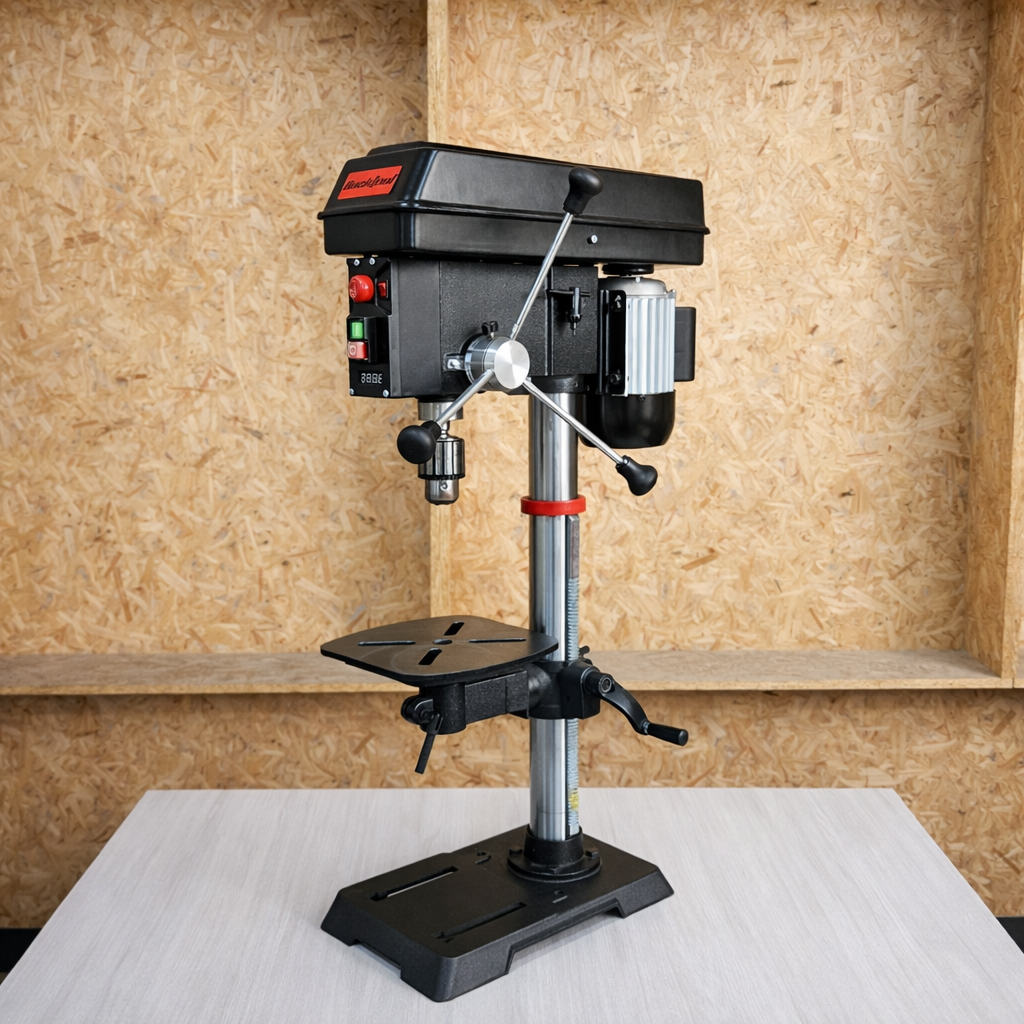
If you’re ready to take your woodworking or metalworking to the next level, a drill press is one of the most valuable tools you can add to your shop. Compared to a handheld drill, a drill press offers superior accuracy, repeatability, and control—making cleaner, safer, and more professional results possible.
With so many models and specifications on the market, choosing the right drill press can feel overwhelming. This guide breaks down the essential terminology, features, and considerations so you can make a confident, informed decision.
Essential Drill Press Terminology
Drill Press Rating (Swing)
A drill press is rated by its swing, which is twice the distance between the spindle’s centerline and the column. This measurement determines the maximum diameter workpiece you can drill in the center.
For example, the BUCKTOOL DP25016A2A 10-inch benchtop drill press features a 5-inch spindle-to-column distance, allowing you to drill a centered hole in workpieces up to 10 inches in diameter.
Spindle Travel
Spindle travel refers to how far the spindle and drill bit can move downward during operation. This specification determines the maximum hole depth that can be drilled in a single pass and is especially important when working with thicker materials.
Speed Control: Fixed vs. Variable Speed
Fixed-speed drill presses operate at a set number of speeds, typically adjusted by moving a belt across stepped pulleys. Variable-speed drill presses allow continuous speed adjustment within a defined range, making it faster and easier to match the correct speed to the material and drill bit being used.
Motor Amperage
Motor power is measured in amperes (amps). Higher-amperage motors provide more torque and consistent performance, especially when drilling hardwoods, using large Forstner bits, or working with metal. BUCKTOOL drill presses are equipped with durable, quiet, low-maintenance induction motors.
How to Choose the Right Drill Press
Available Space
Before selecting a drill press, consider your available workspace. Benchtop models such as the BUCKTOOL DP25016A2A are ideal for compact workshops, while floor-standing models offer greater capacity for larger projects.
Intended Use and Capacity
Think about the materials you plan to drill and the size of your workpieces. Ensure the drill press you choose has enough power, swing, and spindle travel to handle both current and future projects.
Helpful Features
Features such as variable-speed control, built-in work lights, laser alignment systems, and depth stops can significantly improve accuracy, repeatability, and overall efficiency.
Essential Accessories
Accessories like drill press vises, clamps, specialty drill bits, and auxiliary tables increase safety and versatility. Always secure your workpiece properly rather than holding it by hand.
Conclusion
By understanding drill press specifications and matching them to your workshop needs, you can confidently select a tool that delivers precision, power, and long-term reliability. If you need help choosing the right BUCKTOOL drill press, please contact our technical support team at service@bucktool.com.
👉 Visit www.bucktool.com to explore our full range of drill presses.