
A belt sander is only as effective as the belt running on it. Two sanding belts may have the same dimensions and grit number, yet perform very differently because they use different abrasive grains, backing materials, coatings, and joints.
Choosing the right belt helps you remove material faster, control heat, achieve a more consistent finish, and reduce the number of belts used on a project. This guide explains the main types of sanding belts and how to match them to woodworking, metalworking, sharpening, fabrication, and knife-making tasks.

A variable-speed belt sander provides greater control when moving from aggressive stock removal to fine finishing.
Start With the Correct Belt Size
Before considering grit or abrasive material, check the belt size required by your machine. A sanding belt is identified by its width x total belt length, not by the length of one side when laid flat.
Common benchtop belt sizes include:
| Belt size | Typical applications |
|---|---|
| 1 x 30 in. | Sharpening, small parts, light metalwork and hobby projects |
| 1 x 42 in. | Detailed metalworking, sharpening and general shop use |
| 2 x 42 in. | Knife making, bevel grinding, deburring and fabrication |
| 2 x 48 in. | Higher-output metalworking, shaping and stock removal |
| 4 x 36 in. | General woodworking, flattening edges and sanding larger parts |
| 6 x 48 in. | Larger woodworking projects and production-oriented sanding |
The width and length must both match the machine. For example, a 2 x 42-inch belt cannot be installed on a 2 x 48-inch sander. Check the machine label or manual before ordering replacements.
Understanding Sanding Belt Abrasive Grains
The abrasive grain is the cutting material bonded to the surface of the belt. It has a major effect on cutting speed, heat, belt life, and the materials a belt can handle.
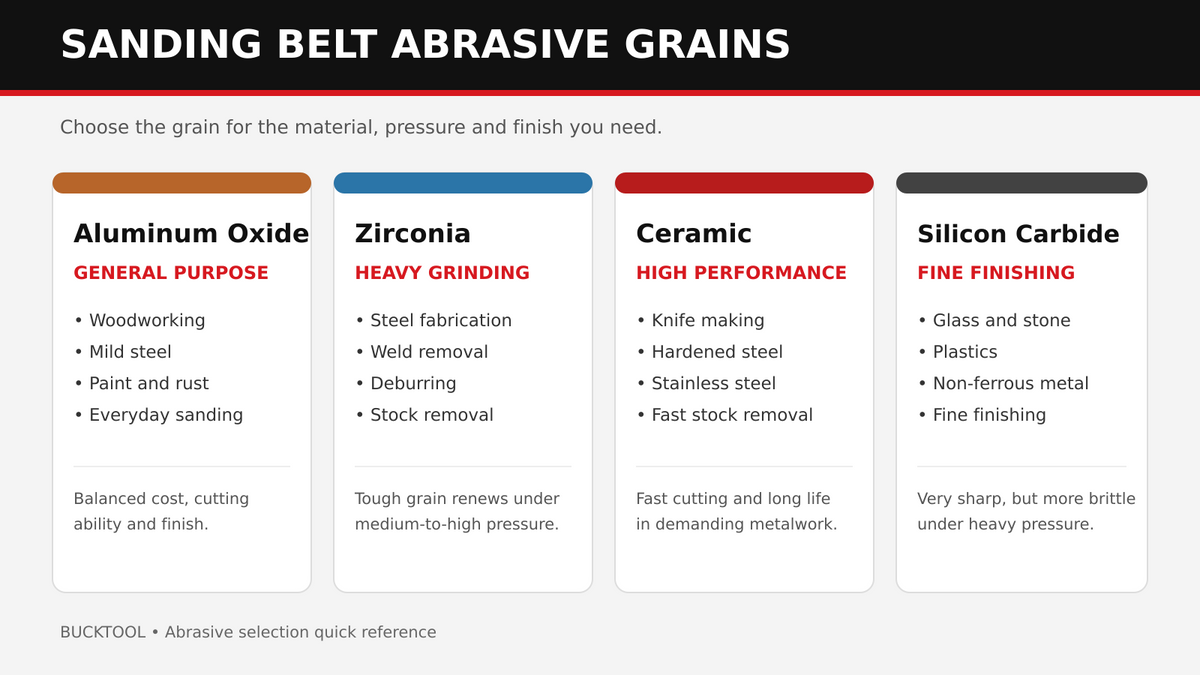
 Comparison of aluminum oxide, zirconia alumina, ceramic and silicon carbide sanding belts
Aluminum Oxide
Aluminum oxide is the most common general-purpose abrasive. It offers a practical balance of cost, durability, and finish quality.
Best for:
- Woodworking
- General-purpose sanding
- Mild steel and light metalwork
- Paint and rust removal
- Projects where belt cost is a priority
Aluminum oxide is an excellent everyday choice, but it may wear more quickly than premium grains during heavy stock removal or sustained grinding on hard metals.
Zirconia Alumina
Zirconia alumina, often called zirconia, is tougher and more aggressive than standard aluminum oxide. Its grains fracture under pressure, exposing fresh cutting edges as the belt wears.
Best for:
- Carbon steel and stainless steel
- Weld removal
- Deburring
- Heavy stock removal
- Medium- to high-pressure grinding
Zirconia belts generally perform best when enough pressure is applied to renew the grain. Very light pressure may not take full advantage of their self-sharpening behavior.
Ceramic Alumina
Ceramic abrasive is designed for fast cutting and long service life in demanding metalworking applications. The grain continually fractures into sharp cutting points rather than becoming smooth and dull.
Best for:
- Knife making and bevel grinding
- Hardened steel
- Stainless steel
- High-pressure grinding
- Fast, repeatable stock removal
Ceramic belts usually cost more per belt, but their higher cutting rate and longer working life can make them more economical for frequent metalworking. They also tend to cut more efficiently, which helps reduce unwanted heat when the belt is used correctly.
Silicon Carbide
Silicon carbide is extremely sharp and produces a clean, refined scratch pattern. However, its grains are more brittle than aluminum oxide, zirconia, or ceramic.
Best for:
- Glass, stone and ceramics
- Plastics and composites
- Non-ferrous metals
- Fine finishing
- Wet-sanding applications when the belt is designed for wet use
Because it fractures readily, silicon carbide is often selected for finishing rather than aggressive, high-pressure grinding.
Non-Woven and Polishing Belts
Not every belt is designed for heavy material removal. Non-woven surface-conditioning belts use abrasive material distributed through a flexible nylon web. They are useful for blending scratches, removing light oxidation, cleaning metal, and producing a satin finish.
Felt, cork, leather, and cloth belts may also be used for polishing or honing, often with an appropriate polishing compound. Always confirm that the belt and compound are suitable for the material and the machine speed.
Sanding Belt Grit Guide
The grit number describes the approximate size of the abrasive particles. A lower number means larger, more aggressive particles. A higher number means smaller particles and a finer finish.

| Grit range | Typical use |
|---|---|
| 24-36 | Very heavy stock removal, rough shaping and weld grinding |
| 40-60 | Shaping metal, bevel development, stripping and aggressive sanding |
| 80-120 | General sanding, scratch refinement and edge preparation |
| 150-240 | Fine sanding and preparation for finishing |
| 320-600 | Fine metal finishing, sharpening and reducing visible scratches |
| 800 and above | Very fine finishing, honing and polishing sequences |
Do Not Skip Too Many Grits
A fine belt removes the scratches left by the previous belt; it is not meant to erase extremely deep grinding marks efficiently. Jumping directly from 40 grit to 400 grit can waste time and wear out the 400-grit belt before the surface is ready.
A practical progression might be:
60 -> 120 -> 240 -> 400 -> 800 grit
The ideal progression depends on the material and desired finish. For rough fabrication, you may stop at 80 or 120 grit. For a polished blade or decorative metal surface, several additional refinement steps may be needed.
Belt Backing: Flexibility Versus Strength
The backing supports the abrasive grain and determines how well the belt resists stretching, tearing, and edge damage.
Paper Backing
Paper-backed belts are commonly used for woodworking and wide-belt sanding. They can produce a consistent surface but are less resistant to moisture, tearing, and aggressive edge grinding than heavy cloth-backed belts.
Cloth Backing
Cloth-backed belts are stronger and more durable, making them common in metalworking and demanding benchtop applications. Cloth backing is often described by weight classifications:
- J-weight: Light and flexible; useful for contours and fine finishing.
- X-weight: A versatile medium/heavy backing for general grinding and finishing.
- Y-weight: Strong polyester backing for high pressure and heavy stock removal.
A stiff Y-weight ceramic belt may be excellent for grinding a flat knife bevel against a platen, while a more flexible J-weight belt is often better for blending curved surfaces.
Polyester and Waterproof Backings
Polyester backings offer high strength and improved resistance to moisture. Some are suitable for wet grinding, but never assume a belt is waterproof. Check the belt manufacturer’s specifications before introducing water or coolant.
Open Coat Versus Closed Coat
The coating describes how densely the abrasive grains cover the backing.
Open-Coat Belts
Open-coat belts leave more space between abrasive particles. The additional space helps carry away sanding dust and reduces loading, making this construction useful for wood, paint, soft materials, and other applications that can quickly clog a belt.
Closed-Coat Belts
Closed-coat belts have dense abrasive coverage. More cutting points contact the workpiece, making them well suited to hard wood, metal, and aggressive material removal. However, they can load more easily when used on resinous wood, paint, aluminum, or other soft materials without the right belt treatment.
Why the Belt Joint Matters
A sanding belt is formed into a continuous loop by joining its two ends. The joint affects smoothness, strength, and whether the belt can run in one or both directions.
- Lap joint: The ends overlap. It can be strong, but the joint area may be slightly thicker.
- Butt joint: The ends meet edge to edge and are reinforced with tape on the back. This creates a more uniform belt thickness and smooth operation.
- Specialty joints: Angled, interlocking, or specially skived joints may be used for particular materials and finishing requirements.
Follow the directional arrow printed inside the belt. Some butt-jointed belts are bidirectional, but a directional belt should never be installed backward.
Choosing a Belt by Material and Task
| Material or task | Recommended starting point |
|---|---|
| General woodworking | Open-coat aluminum oxide, 80-120 grit |
| Removing paint or finish | Open-coat aluminum oxide, 40-80 grit |
| Mild-steel fabrication | Zirconia or ceramic, 40-80 grit |
| Weld removal | Zirconia or ceramic, 36-60 grit |
| Stainless steel | Ceramic belt with grinding aid, 40-120 grit |
| Knife bevel grinding | Ceramic, 36-80 grit; progress to finer belts |
| Sharpening and edge refinement | Flexible aluminum oxide or ceramic, commonly 120 grit and finer |
| Aluminum and soft metals | Belt designed to resist loading; use appropriate speed and light pressure |
| Satin metal finish | Non-woven surface-conditioning belt |
| Final polishing | Cork, felt, leather or cloth belt with a compatible compound |
These are starting points rather than fixed rules. Belt speed, contact pressure, contact-wheel hardness, platen condition, and workpiece geometry can all change the result.
Matching the Belt to Your Bucktool Sander
Different machine formats favor different projects.
Compact 1 x 30-Inch Sanders
A compact Bucktool 1 x 30-inch belt and disc sander is convenient for small woodworking parts, edge cleanup, sharpening, and routine shop projects. Keeping several aluminum oxide belts from 60 through 240 grit covers many everyday tasks.
2 x 42-Inch Sanders for Metalworking and Knife Making
The Bucktool BS242V variable-speed 2 x 42-inch belt sander provides a broad belt-speed range for transitioning between stock removal and controlled finishing. Ceramic belts are a strong choice for bevel grinding, while flexible finer-grit belts help refine scratches and contours.

A 2 x 42-inch belt offers useful surface area for sharpening, deburring, shaping, and general metalworking.
The Bucktool BG2600 belt sander and bench grinder combo combines a 2 x 42-inch sanding belt with a 6-inch grinding wheel for sharpening, deburring, shaping, and finishing.
2 x 48-Inch Sanders for Higher-Output Grinding
For heavier stock removal, the Bucktool CH50BS 1 HP 2 x 48-inch belt sander pairs a larger belt format with a rigid platen and contact-wheel setup. Durable zirconia or ceramic belts are generally the best match for demanding metalwork.

4 x 36-Inch and 6 x 48-Inch Sanders for Woodworking
Wider belts provide more support for furniture parts, boards, frames, and general woodworking. Aluminum oxide belts are usually the most practical option, with open-coat products helping reduce loading on softer or resinous wood.
Explore the full Bucktool belt sander collection to compare belt sizes, motor power, speed options, and machine configurations.
How to Extend Sanding Belt Life
- Use the correct abrasive for the material. A general-purpose wood belt may wear rapidly during heavy steel grinding.
- Let the abrasive cut. Excessive pressure creates heat and can damage the belt, workpiece, or motor.
- Use appropriate belt speed. Lower speeds can provide better control and reduce heat on delicate work, while higher speeds support efficient stock removal with the right abrasive.
- Keep the belt tracking correctly. A belt rubbing against the machine housing will quickly damage its edge.
- Avoid contamination. Do not use the same fine-finishing belt on dirty, rusty, or oily surfaces.
- Clean woodworking belts appropriately. A rubber abrasive-cleaning stick can remove some wood dust and extend useful life.
- Store belts properly. Keep them away from extreme heat, moisture, and tight bends that can distort the backing or joint.
Safety Tips for Belt Sanding
- Wear safety glasses or a face shield and suitable hearing protection.
- Use effective dust collection or respiratory protection for the material being sanded.
- Keep guards, work rests, and shields correctly adjusted.
- Allow the machine to reach a stable speed before applying the workpiece.
- Hold small parts with a suitable fixture or tool rather than placing fingers near the belt.
- Grind in a direction that will not pull the workpiece into a gap or throw it toward the operator.
- Be aware that metal sparks can ignite wood dust, finishing materials, rags, or nearby combustibles.
- Disconnect the machine from power before changing belts or making adjustments.
Always follow the instructions supplied with your sander and abrasive belt.
Frequently Asked Questions
What is the best all-purpose sanding belt?
For general woodworking and occasional light metalwork, aluminum oxide offers the best balance of price and versatility. For regular steel grinding, zirconia or ceramic usually provides better cutting performance and belt life.
Is ceramic better than zirconia?
Ceramic generally cuts faster and lasts longer in demanding applications, especially on hard steel and stainless steel. Zirconia is a durable, cost-effective option for general fabrication, weld removal, and medium-to-heavy grinding. The better choice depends on the material, pressure, machine power, and required finish.
What grit should I use for sharpening?
The correct grit depends on the condition of the edge. A damaged or very dull tool may need a coarse belt for reshaping, while routine sharpening and refinement require finer grits. Remove as little material as necessary and control heat carefully, particularly on hardened cutting edges.
Can one sanding belt be used on both wood and metal?
It may be physically possible, but it is better to keep separate belts. Metal particles can become embedded in a belt and scratch wood, while resin and wood dust can load the belt and reduce metal-grinding performance. Separating belts also makes it easier to maintain a predictable finish.
Why does my sanding belt keep clogging?
Loading is common when sanding resinous wood, paint, aluminum, or other soft materials. Use a belt designed for the material, consider an open-coat or anti-loading product, reduce excessive pressure, and verify that the belt speed is appropriate.
Final Takeaway
Choosing a sanding belt is about more than selecting a grit number. Start with the correct size, then match the abrasive grain, backing, coating, and flexibility to the material and the type of contact your project requires. Aluminum oxide is a dependable general-purpose option, zirconia handles demanding fabrication, ceramic excels at high-performance metal removal, and silicon carbide supports specialized finishing tasks.
With the right belt and a properly configured sander, you can work faster, control heat more effectively, and achieve a cleaner, more consistent finish.
Shopify Publishing Notes
Suggested excerpt: Choosing the correct sanding belt can improve cutting speed, belt life and finish quality. Learn how abrasive grains, grit, backing and belt construction affect woodworking, metalworking, sharpening and knife-making results.
Suggested featured-image alt text: Bucktool belt sander with sanding belts for woodworking, metalworking and knife making.
Suggested CTA button: Shop Belt Sanders
CTA link: https://bucktool.com/collections/belt-sander
Recommended image order:
- Hero: BS242V product image or an original workshop action photo.
- Abrasive grain comparison infographic after “Understanding Sanding Belt Abrasive Grains.”
- Grit progression infographic after “Sanding Belt Grit Guide.”
- BG2600 or CH50BS application image in the Bucktool product section.
Editorial note: Product availability, specifications and URLs should be checked immediately before publishing.